
Chapter Six
How Time Works
(This chapter was first published on Medium on 8/10/25 at https://medium.com/@t.higginson/how-time-works-6fdeaf968008)
A thought experiment for how Time (past, present and future), gravity, intentionality and God(s) work in a single framework
Author's note: This chapter/essay is included because the analysis about how time works was formative to the concept that the most fundamental, the most core, foundation to anything and anyone (animist) is their time. From that point, the concepts of harmonious biodiversity and then inalienable obligations took clearer form. However, the ideas in this chapter are not required for the validity of inalienable obligations and harmonious biodiversity. Therefore, this chapter is intended for the curious who are intrigued to dive deeper, or to look beyond the veil so to speak, at precursor thought experiments.
Professor Feynman once remarked ““Study hard what interests you the most in the most undisciplined, irreverent and original manner possible.”
I’ve been fascinated by the concepts of and relation between time and gravity for many years, even decades.
So here goes, starting with an assertion from a well-known point of departure.
Schrödinger’s infamous cat is truly neither alive or dead until the present moment, meaning the moment when an observer opens the metaphorical box to peek inside.
Anytime in the future, the cat’s entirety is defined exclusively by a set of statistical probabilities based on a set of equations, a set of dynamic weightings and a set of data streamed to the equations from the contiguous present moment.[1] The statistical probabilities converge towards one outcome (e.g., the cat exists materially, and is alive or dead) at the present moment evolves. The statistical equations of the nearest future continuously cascade into and evolve[2] the present moment.
The state of the “cat” resolves to alive or dead at the present moment. That state in the present moment is what becomes the full definition of the entire past as relates to the cat (whether the term “cat” refers to an atom, an actual cat, the cat and its box[3], or everything across the universe involved in the process of resolving statistical probabilities into a present moment), and is the data streamed to the statistical probabilities matrix of the future.
For purposes of the resolving of the cat’s state from the future matrix of statistical possibilities (e.g., there is a cat, it has a set of physical characteristics (long fur, stripes, 3 years old, its DNA, its evolutionary history, etc.), mental characteristics (hungry, dreaming, memories, emotions, etc.) and a mix of both (alive or dead, responsibilities for its actions/inactions, etc.)), the observer is the cumulative determinations of a sufficiently close approximation to a resolution to actuality of all statistical probabilities at the present moment. In other words, there is no separate observer.
How might this work across the reaches of the galaxy? The present moment on the far side of the universe is certainly remote from a physical distance perspective. But (1) the “present moment” is the present moment simultaneously everywhere in the universe, meaning zero distance from a “time” perspective, and (2) the statistical impact (forward-looking influence on the set of all statistical equations across the universe) of resolving the statistical probabilities into the actuality of the present moment diminishes as the physical distance grows from the local present “box.” (At some distant physical and/or future point(s) in the statistical probability matrix field the impact would asymptotically approach zero, but the impact will never be zero no matter any type of distance).[4]
The statistical probabilities field matrix become ever less calculable (both more theoretical and less present moment data-input impact) the farther into the distant future of the statistical probability matrix field. They become increasingly less calculable in part because the impact of resolved data of the present moment has less and less impact as statistical probabilities extend into the future farther from the present moment, and also because, among other factors, all weightings in statistical probabilities become ever more dependent on larger sets of non-resolved statistical probabilities with interwoven parameters across larger and larger physical distances of the universe.
This means there is no future to travel to. The future is an ever less resolvable matrix of statistical probabilities stretching into the future. All matter exists only in the present moment, resolved from statistical probabilities based in part on data streamed to the statistical probability equations forward into the infinite statistical possibility matrix field across physical distances and future time.
This also means there is no past to travel to.[5] There is no accumulation of layers of past present moments; there is no analog in time to geologic layers. Prior to the present moment, there is simply nothing, a null set, no time, no matter, no statistical probabilities, no past of any kind.
In summary:
The present: is the present moment (physical matter and meta-physical) across the entire universe that resolves on a continuous basis out of the future statistical probabilities. The present moment is immeasurably brief, and is the only actualization of matter. The present moment continuously and seamlessly evolves, meaning, for instance, that there is no discrete or quantized aspect to time. There is only the one present moment ever. It is always the present moment. There are no past present moments. There are no future present moments.[6] (See Diagram 2 below.)
The past: does not exist, except to the extent it is encapsulated in the present moment.
The nearly immediate future: is a matrix of highly accurate and predictable (i.e., deterministic) statistical probabilities of what the present moment will evolve to be in the very near-future.
Farther from the immediate future: a matrix field of less and less predictable and resolvable statistical probabilities the farther projected into the future from the present moment.
The Observer: the aggregate resolution of statistical probabilities in the process of resolving to the present moment, essentially the boundary line between the present moment and the future.
Therefore, what is time?
Time is the combination of (1) an interwoven, non-digital, multi-dimensional, infinite lattice of unresolved statistical probabilities that (a) become ever less susceptible to being predicted the farther into the future from the present moment, and (b) continuously resolve at the boundary of the nearest future and the present moment using streamed actualized present moment state data for their resolution, and (2) the present moment, which feeds its actualized/resolved state data into the lattice of future statistical probabilities.
In case diagrams are helpful, see next page.
Diagram 1:
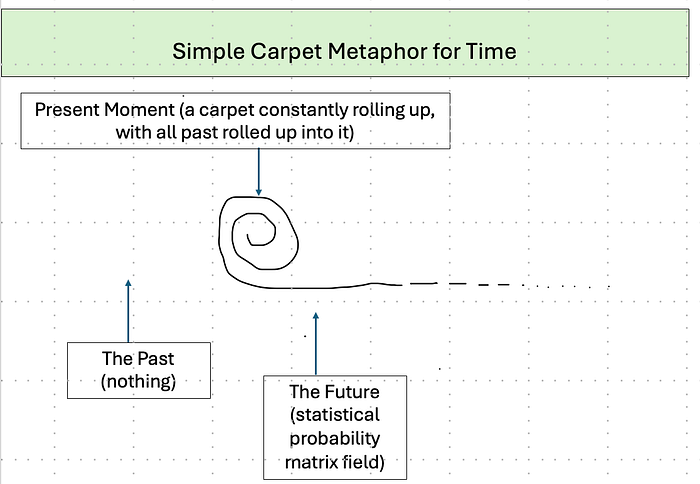
Diagram 2:
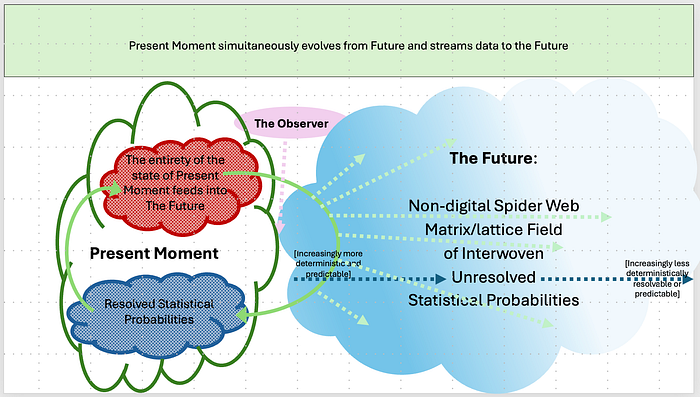
Diagram 3:
For example, Archduke Franz Ferdinand was shot and assassinated at the present moment (as cataloged by one human calendar and time-keeping measurement system as Sunday, 28 June 1914 at 10:45 am). The assassin pulled the trigger on his gun at the present moment, which immediately became the past (i.e., nothing), and streamed to the statistical probabilities of the future. The trajectory of the bullet and the trajectory of the Archduke’s body were highly (but not absolutely) predictable (and modellable) to meet in a short window of future time at a specific physical location with a specific outcome, calculable by physics, statistical equations and weighting and medicine/biology/other scientific disciplines and the streamed forward totality of the actualized state of the present moment. In the continuum of transitions of future statistical probabilities into the present moment along the bullet’s trajectory, statistical probabilities across the universe were resolving themselves, much as the cat’s state is resolved by an observer looking inside the box, where the observer is the aggregate of on-going instantaneous resolutions of the statistical probabilities into the present moment across the universe.
The entire actualized state of the present moment of the Archduke’s death gets streamed to the statistical probabilities of the future[7], and thereby ripples outward into the future to impact (by way of, at least, both resolved state information and by way of changed weightings) the equations of statistical probabilities on a world-scale as the present moment’s state streams into and is assimilated into the statistical equations going forward from the present moment of the Archduke’s death. However, the impact of the local transition of statistical probabilities into the actuality of the present moment, for instance, the Archduke’s death, make little (but never zero) change to the resolution of statistical probabilities defining the same present moment the farther the physical distance increases from the physical location of (and the distance into future from) the assassination across the universe.
By way of an example, the present moment when the Archduke’s assassin’s finger pulled the trigger dramatically changed the future statistical probability matrix field. But, at least for a while, the impact on the matrix field was very local and not at all resolvable in its larger impact. For a draft-age boy in the UK at the present moment with the trigger-pull, the statistical probabilities of the near-term future in the local physical area of the boy would hardly have been impacted by the trigger pull. As the present moment is eventually informed by/formed by the impact of the propagating wave driven of the present moment data stemming from the impact of the trigger pull streaming into the statistical probability field of the future, the impact widens eventually into the actuality of WWI, including the present moment years forward when the boy is in a specific trench in a specific field in France, albeit that the impact of the trigger pull on the place and position of the earth and other planets, at the present moment’s state when the boy was in the trench, in their spiraling motions orbiting their sun and the solar system moving in its arm of the Milky Way Galaxy would have continued to be very nearly exactly resolvable in the statistical probabilities field all the way back to the actualized state of the present moment of the trigger pull by the assassin.
Matter is only a set of statistical probabilities (essentially, the cat) as resolved into actual matter only at the present moment. The statistical probabilities of time are constantly converting/transitioning into matter at the continuously evolving present moment.
As part of the data streamed to the statistical probabilities matrix from the present moment, the physical properties/parameters of the physical location affects the specifics of the result of the conversion.[8] A key parameter is the location where conversion from statistical probabilities to matter occur in a “gravity well” (more properly, a “clockspeed gradient field”).[9]
The conversion the other way, from matter in a present moment into statistical probabilities, does not happen except to the extent of the streaming of the actualized present moment to future statistical probabilities.[10] The entire past is represented solely in the sum of the resolved data in the present moment, which data gets streamed to the statistical probabilities of the future.[11]
In this framework of time, where and how does gravity arise? What even is gravity in this framework. For answers, see footnotes 6, 7 and 8.
In this framework of time, where do “Intentionality[12]” and God(s) fit in? How does this structure of time allow for the existence of intentionality and even God(s)?
Regarding “intentionality,” because prior “resolved” statistical probabilities affect all future statistical probabilities (through the present moment’s evolution only, not somehow leapfrogged up from some ancient layer(s) of past present moments), then “crowd” or “collective” influence and “intentionality” is not only possible, but likely given, for instance, that meta-physical data is part of what streams to impact the future’s matrix of statistical probabilities. Intentionality of any kind would be dynamically allocated weights as a parameter in the resolution of at least local and distant statistical probabilities occurring at the present moment.[13]
“Intentional” God(s)[14] could also exist in this framework, possibly by “living” within the matrix of future statistical probability equations and intentionally changing weights of parameters in one or more statistical probability equations somewhere in the future matrix. Random permutations and/or vibrations or oscillations could be part of the statistical probability equations in the matrix of future statistical probabilities. Non-random[15] directional interference with weighting and/or imposition of permutations/vibrations/oscillations might be consistent with the proposed model, albeit not required.
All this begs for a metaphor to help wrap our heads around what is described, much as the warping of time/space by masses into surface topologies of gravity wells is a metaphor that has stuck in the minds of scientists and the public to convey much of the currently generally accepted structure of the space/time fabric of the universe.
One version of a metaphor is a carpet rolling up (see Diagram 1), where the present moment is the current roll, the past is gone (rolled up) and the future statistical probability matrix field is the weave of the unrolled portion of the carpet. This metaphor is relatively simple to understand and visualize, and does not imply a beginning (the carpet’s past can have been infinitely long before any present moment). However, it suggests a flatness that is not intended.
Another version of a metaphor is an ever expanding spherical shock wave shell where there is nothing (the past) inside the shell. The present moment is the leading edge of the shock wave shell. The future is an infinite cloud in every direction outside of that leading edge, made up of an interwoven, ever and continuously updating matrix of statistical probabilities. This metaphor also presents an important point of emphasis by forcing the question of how you can have essentially a vacuum of nothingness inside an expanding spherical shell surface (the present moment) surrounded by an infinite (albeit increasingly rarified and theoretical) matrix of statistical probabilities? By completely inverting the notion that you need something inside and an origin point and a force(s) to drive and/or restrain the expansion and a “nothing” on the outside, this metaphor more properly conveys the new proposal. But this metaphor implies an origin point of physical location and an original present moment (the point of creation of an observer and also possible the statistical probability matrix field) which may make no sense. The metaphor also suggests that physical distances between matter in the present moment expand continuously.
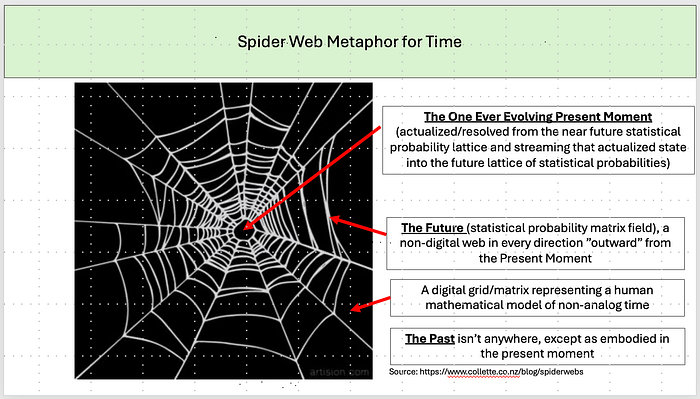
Diagram 3 present the preferred metaphor: Time is the present moment in an infinite, interwoven and multi-dimensional lattice (web/matrix) of statistical probability equations stretching in every direction, with the present moment ever-evolving interactively with near-future statistical probabilities and flowing present moment actualized state data into the future statistical probabilities such that they are also ever-evolving.
Regardless of the most helpful metaphor, this proposal relegates the impossible matter-centric attempt at a unified theory of everything to a proper dustbin. Time consisting of an ever-evolving present moment and an infinite field of interwoven statistical probability matrices defines everything. Matter only makes an appearance as part of the present moment.
Why not just use the Heisenberg’s metaphor of Shrödinger’s cat? The reason is that the cat/box metaphor is a starting point for the questions to ask and thought experiments that lead to this proposal for the framework of time.
In that sense, though, writ large, the cat and the box are the explanation for time, gravity, the universe, individual and collective intentionality, gods, personal and societal obligations and responsibilities, and everything.
With a bow-down to the brilliant “This Is How You Lose the Time War” by Amal El-Mohtar and Max Gladstone,
and
to the equally brilliant and totally different “When We Cease to Understand the World” by Benjamin Labutat
Notes
[1] While the phrase “contiguous present moment” may make it sound like there is a sequence of discrete (quantized) present moments, the semantics are not intended to suggest anything but a continuum of a single ever evolving present moment, and not to suggest or mean that any part of time is made of data from quantized present moments.
[2] “Resolve,” “transition,” “convert, “fix” and related terms are used interchangeably to convey the effect of the transition from statistical probabilities to a materialized actuality of matter at the present moment.
[3] In theory, if the box sufficiently isolates the interior from all other statistical convergences across the universe, the statistical probabilities defining the cat’s state could remain unresolved because no present moment occurs, but, that would entail essentially removing the box’s interior from the universe.
[4] With entanglement, the impact may be the same as if the equation coming to a solution is local on both ends of the entanglement.
[5] Not only is there no past to travel to, the past cannot be changed, because it does not exist. However, in theory, an imposed change at the present moment could be made such that the data streamed to the future would have the effect of making the future look like the past had been changed. In practice, this would be impossible for any number of reasons, including that the imposed change would have to change the impact on the statistical probabilities of the entire propagation of all data ever already streamed to the future, throughout all of the future.
[6] The location, motion and size of the present moment is irrelevant, meaning any motion or no motion are equivalent for the present moment and any size from a singular point to anything bigger of any shape is equivalent too). The motion of the present moment could, for instance, be outward expansion (perhaps like a spherical shockwave boundary), or no movement (with the infinite future streaming or being pulled inwards to it), or any other motion.
[7] The data representing the resolved actuality that is the totality of the present moment that is streamed to the future includes everything from the then-present moment: physical matter, thoughts, emotions, dreams, literally everything physical and meta-physical, individually and collectively. Schrödinger’s speculation that a sufficient concentration of human will having a place in the physical universe comparable to the sufficient concentration of matter compressed into a small enough space to create a singularity is realized in this mode, as described more in the discussion around the concept of collective “intentionality” discussed in my essay (see link in footnote 8 below) on “Do Gods with Intentionality Exist, and Why Does It Matter?
One key piece of data that is passed from the actuality of the present moment to future statistical probabilities equations is the physical location of any and all matter. The physical location includes the location in the clockspeed gradient field, which is a highly weighted factor in the equations as they transition statistical probabilities into the actuality of the present moment. The physical distance among parts of the actuality of the present moment is also a key weighted factor, and a separate factor from the location in a clockspeed gradient field, which is a data point independent of physical location. While both physical location and location in a clockspeed gradient field are critical data points passed to and input into the statistical probabilities of the future, all the other data points individually and collectively of the current actuality (i.e., present moment) are also passed to the statistical probability equations of the future, albeit these other data points are weight differently, and the weighting is dynamic based on the context.
[8] See earlier essays/thought experiments where I conflated time and statistical probabilities at, e.g., https://medium.com/@t.higginson/gravity-does-not-exist-only-time-exists-233297b1cc9d
[9] In this framework, gravity does not exist. Gravity wells are actually clockspeed gradient fields, as described in my pieces at the link in footnote 7 above. This does not change the net effect of the so-called gravitational force, it only means that the mechanism behind that force is not something called gravity, but, instead is a by-product of the ever-ongoing conversion of statistical probabilities into the actualized state of the present moment. The clockspeed gradient field is in many ways a one-to-one mapping onto a gravity well, except that there is nothing to “fall into.” The metaphor of a “well” does not hold or apply. Instead, there is a gradient field where clockspeeds slow as the physical location of matter approaches areas with more physical mass. Perhaps high atmospheric pressure/low atmospheric pressure analogy is much more apt than “gravity well.” It may be that as clockspeeds slow in regions of the clockspeed gradient field, including into a singularity, what is happening is a more complete transition of the statistical probability fields into matter to the point where nothing exists except matter and the statistical probability equations are extinguished as relates to that singularity of matter (which may be equivalent to the matter being removed from the rest of the universe, untouchable by time). In other words, the future aspect of time is matter, just matter in a different form: an aspect of the future’s statistical probabilities. Using a different (and, of course, imperfect) metaphor, matter is like ice, the future of aspect of time is like water, and the boundary between the future and the present moment is the freezing point, with gravity being a by-product of the conversion of states of the “water” aspect of future statistical probabilities into “ice.”
[10] How might this impact the design of the “Time Engine” that I have written about as the next critical step function away from rocket engines and societies based on explosions? That is a topic for a separate essay and investigation.
[11] In theory, but not realistically in practice, you could re-construct the past by reverse engineering the sum of all relevant data across all resolved data of a present moment, unwinding all resolved statistical probabilities to get to a past present moment. This would not change the past per se, but would allow for a change to the data in a present moment as if the past had been changed and that change were reflected in all resolved statistical probabilities leading to the present moment. And, that newly re-engineered present moment would affect future statistical probabilities.
[12] Learn more about the concept of “intentionality,” its definition and context in my essay “Do Gods with Intentionality Exist, and Why Does It Matter” at https://medium.com/@t.higginson/do-gods-with-intentionality-exist-and-why-does-it-matter-e52438a56a4f
[13] See footnote 7 above about the scope of the actualized state of present moment that is streamed to the statistical probability equations of the future.
[14] See footnote 12 above with a link to my essay on “Intentionality.”
[15] “Non-random” and “random” are carefully defined in the Intentionality essay linked to in footnote 12.